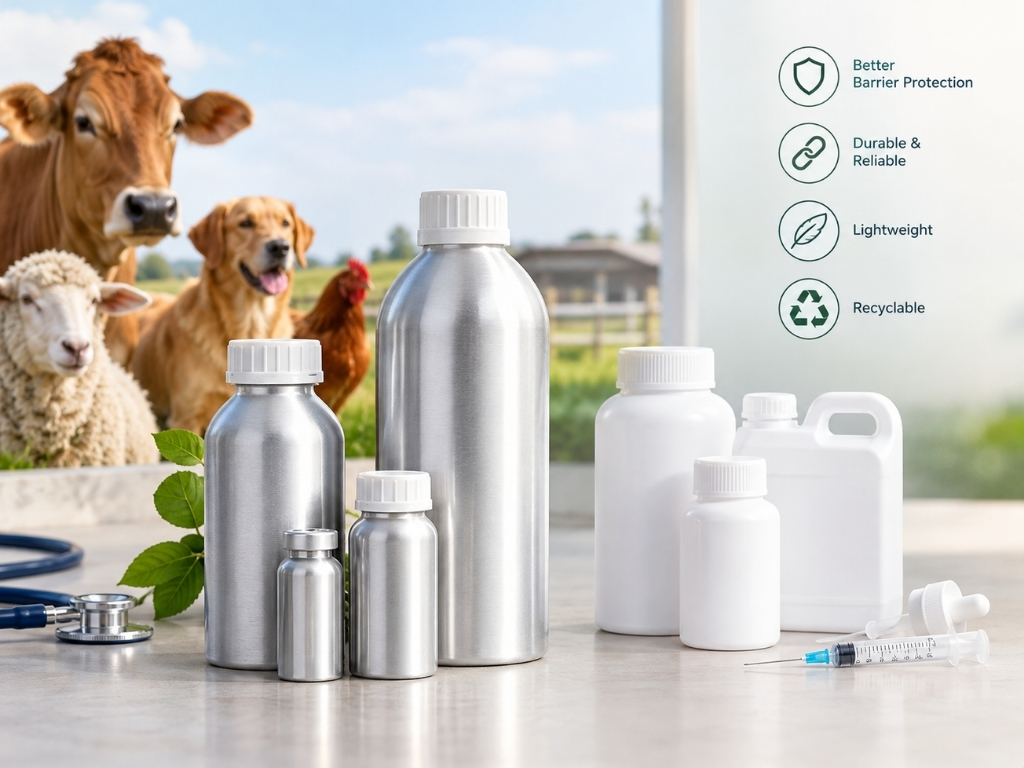
Veterinary product manufacturers need packaging that can protect formulations during storage, transportation and use. While plastic remains widely used across animal-health packaging, aluminum packaging for veterinary products is gaining attention where stronger barrier protection, durability and sustainability are priorities.
For manufacturers evaluating packaging materials, the choice between aluminum and plastic depends on the formulation, required shelf life, compatibility and intended application.
1. Superior Protection from Light, Moisture and Vapour
Certain veterinary formulations can be affected by exposure to light, moisture or air. Aluminum provides an effective barrier against these external factors, making it suitable for products where environmental protection is important.
Ace Packaging‘s aluminum bottles and containers are light- and vapour-proof, supporting the protection of sensitive contents.
2. Durable Packaging for Storage and Transport
Veterinary products can move through distributors, warehouses, clinics and agricultural environments before reaching the end user. Packaging therefore needs to withstand handling and transportation.
Aluminum containers offer a combination of lightweight construction and mechanical durability. Ace Packaging’s aluminum packaging is lightweight, durable, shock-resistant and leakproof.
3. Aluminum Supports Sustainability Goals
Packaging sustainability is increasingly relevant to B2B manufacturers and brands. Aluminum is recyclable and can be recycled repeatedly without losing its fundamental material properties. Ace Packaging’s aluminum bottles and containers are recyclable packaging solutions.
However, recyclability alone does not make one material automatically better for every veterinary application. Manufacturers should consider the complete packaging lifecycle, including production, transportation, use and end-of-life management.
4. Aluminum vs Plastic: Which Should Manufacturers Choose?
Plastic remains an important veterinary packaging material because of its versatility, cost-effectiveness and established use in bottles, syringes and other formats.
Aluminum may be preferable when manufacturers prioritise:
- Strong light and vapour protection
- Durable packaging
- Lightweight metal containers
- Premium and distinctive packaging
- Recyclability
The final choice should be based on product compatibility, internal coating requirements, closure design, regulatory requirements and cost.
Aluminum is not a universal replacement for plastic in veterinary packaging. Instead, it provides a valuable alternative for manufacturers whose formulations and supply chains benefit from barrier protection, durability and recyclable packaging. With aluminum bottles and containers available in different sizes and configurations, manufacturers can evaluate aluminum as part of a fit-for-purpose veterinary packaging strategy.
FAQs
Is aluminum packaging suitable for veterinary products?
Yes. Aluminum bottles and containers can be suitable for compatible veterinary formulations, particularly where protection from light, vapour and handling is important.
Is aluminum better than plastic for veterinary packaging?
Neither material is universally better. The appropriate choice depends on formulation compatibility, barrier requirements, packaging format, cost and regulatory considerations.
Can aluminum packaging be customised?
Yes. Aluminum packaging can be supplied in different formats and can be customised for specific brand and application requirements.
Is aluminum packaging recyclable?
Yes. Aluminum is recyclable and can be recycled repeatedly while retaining its material properties.
This article is for general information only and is not technical, regulatory or professional advice. Please verify independently and consult qualified experts before making packaging decisions. See our full Disclaimer .